TL;DR: Hiring decisions are facing more scrutiny, and faster candidate selection does not help if the process cannot explain what it measures, why those measures matter for the role, and how decisions are made. Validated assessments give hiring teams a stronger foundation than resumes, credentials, self-reported skills, or unstructured interviews by helping organizations evaluate candidates against objective job-relevant criteria, apply those criteria consistently, and connect hiring signals to outcomes such as performance, retention, and quality of hire. For senior leaders, the real test is simple: if a hiring decision were challenged, could the organization defend how that decision was made? The answer depends on whether the process is built on valid signals, structured evidence, fairness, and accountable human judgment.
*****
Hiring is under intense scrutiny while at the same time talent acquisition leaders are under pressure to move faster, reduce cost, improve quality of hire, and support business functions whose workforce needs are changing quickly. Gartner identified cost pressure, high-volume recruiting, changing recruiter skills, and the reshaping of assessment as major talent acquisition trends for 2026.¹
That pressure should change how executive teams evaluate hiring systems and processes. The question is not only whether a process can move candidates through a workflow faster. The stronger question is whether the process can be explained, validated, governed, and defended when someone asks why one candidate advanced, why another did not, and whether the criteria were actually related to the work.
For CEOs, CFOs, CHROs, COOs, and talent leaders, defensibility is now part of hiring performance. A process that produces speed without validity creates risk. A process that relies on weak proxies creates inconsistent decisions. A process that cannot connect selection criteria to role outcomes weakens quality of hire, fairness, compliance readiness, and Return on Talent Investment, or ROTI.
The organizations that will build more resilient hiring systems are not the ones that add the most complexity to selection. They are the ones that know what they are measuring, why it matters, how it predicts performance, and how human judgment remains accountable at the decision point.
1. Scrutiny is a business issue, not a compliance afterthought
Hiring scrutiny now reaches beyond HR compliance. It affects employer brand, workforce quality, operating risk, and the credibility of talent decisions in front of the CEO and CFO. When selection systems influence screening, assessment, ranking, or advancement, leadership teams need a process that can withstand questions from candidates, regulators, legal teams, hiring managers, and boards.
The Equal Employment Opportunity Commission states that employment tests and selection procedures can raise issues under federal equal employment opportunity laws when they screen out protected groups, are not job-related and consistent with business necessity, or are not properly validated when adverse impact exists.² The Uniform Guidelines on Employee Selection Procedures provide a foundational U.S. framework for evaluating selection procedures, including validation expectations when a procedure has adverse impact.³
For executives, the implication is practical. Defensible hiring requires more than confidence that a process works. It requires evidence that the selection process is measuring job-relevant capabilities in a consistent and documented way. It also requires enough governance to show how the organization monitors outcomes, handles human judgment, and improves the process over time.
A validated, job-relevant assessment can help create consistency across a large candidate pool. A poorly defined screen can replicate weak assumptions at volume. The difference is whether the organization has built the process on valid signals.
2. Validity begins with the work
A defensible hiring process starts with the job. Before leaders approve screening, assessment, matching, or ranking criteria, they need a clear view of the work being performed, the capabilities required, and the evidence that those capabilities predict success.
The EEOC explains that employers may need to show that a test or selection procedure is job-related and consistent with business necessity.² In practical business language, that means a hiring process should be able to answer four questions:
- What does the role require?
- Which capabilities predict success in the role?
- How are those capabilities measured?
- What evidence shows the measurement is fair, consistent, and job-relevant?
This is where validated assessments matter. A validated assessment is not simply a test placed inside a hiring workflow. It is a selection procedure built around the actual requirements of the job, supported by evidence that the assessment measures something meaningful for performance, readiness, or role success.
Harver’s assessment system is grounded in science-backed measurement. Its predictive assessments are designed to identify candidates who are a strong fit for specific roles through role-relevant evaluation, and its skills-based hiring approach starts with job analysis, predictive assessments, evidence-based validation, and the connection between pre-hire skills data and post-hire outcomes such as retention and promotability.⁴ ⁵
The business value sits in the measurement logic. If the work changes, the organization needs to know which capabilities matter and how to measure them before hiring decisions scale.
3. Defensibility depends on explainability, consistency, and human judgment
Hiring processes can fail under scrutiny when leaders cannot explain the basis of the decision. Internal stakeholders do not need to audit every step to ask whether the process is fair. The organization should be able to explain what is measured, why it is measured, how the result informs the process, and where human judgment enters the decision.
That last point matters. Validated assessments should inform human judgment, not replace it. A strong hiring process gives decision-makers structured evidence before they make the final call. It also creates a clearer record of how candidates were evaluated and which criteria mattered.
Human judgment should answer specific questions. Who reviews assessment outputs? When can a hiring leader challenge or contextualize the evidence? What additional information is considered? How are exceptions documented? How are outcomes monitored across candidate groups? How does the organization learn from post-hire performance and retention data?
Consistency matters just as much. Unstructured interviews, resume screens, and informal manager preferences can create inconsistency because different candidates are evaluated against different standards. A job-relevant assessment process can create a more consistent evidence base before human judgment is applied.
The strongest hiring systems do not ask leaders to choose between speed and scrutiny. They create a process where speed comes from better structure, not weaker evaluation.
4. Fairness requires objective criteria and ongoing monitoring
Fairness in hiring cannot depend on good intentions. It requires objective criteria, structured measurement, outcome monitoring, and a willingness to adjust the process when the data shows a problem.
The EEOC states that employers are responsible for employment tests and selection procedures that have an adverse impact on protected groups unless they are job-related and consistent with business necessity.² The Uniform Guidelines also describe adverse impact concepts and validation expectations for employee selection procedures.³
For leadership teams, this creates a governance requirement. If a selection process screens, ranks, or advances candidates, the organization should know whether outcomes differ materially across groups. If differences appear, leaders need a process for investigating whether the selection criteria are job-relevant, whether the assessment is functioning as intended, and whether alternative approaches could reduce adverse impact while still measuring the capabilities required for the role.
Validated assessments help because they are built around objective job-relevant criteria rather than vague impressions. Skills-based hiring can reduce reliance on credential proxies that often reflect unequal access to education, networks, and prior opportunities. A resume tells where someone has been. A structured, validated assessment can show what they can do and how they are likely to perform against role-relevant demands.
That distinction is not only a fairness issue. It is a talent strategy issue. If an organization over-relies on proxies, it may exclude capable candidates who did not follow traditional paths. If it uses structured, job-relevant measurement, it can widen the pool of people with demonstrated capability while giving every candidate a clearer chance to show what they can do.
5. Defensibility becomes visible in outcomes
A defensible hiring process should hold up in documentation, and it should also hold up in business outcomes. Strong assessment design should improve the quality of decisions, not only the appearance of governance.
Paramount Advertising used Harver to support a more standardized, data-driven entry-level sales hiring process after recognizing the need to build a workforce pipeline that better reflected the diversity of the audiences it serves. The company reported a 254% increase in ethnic diversity, a 56% reduction in attrition, a 12% increase in employee performance, and a 30% reduction in recruiting time.⁶
The lesson is not that every organization should copy Paramount’s hiring model. The lesson is that structured, science-backed assessment can create a stronger connection between fairness, quality of hire, and operating performance. When talent decisions are based on validated signals rather than informal judgment, leaders can improve the process, defend the criteria, and measure whether hiring decisions are generating return.
That outcome orientation is especially important as hiring systems become more digital, faster, and more data-driven. A process can look more sophisticated without becoming more predictive. Leaders should be cautious of any hiring process that improves throughput but cannot explain how candidate signals relate to role success.
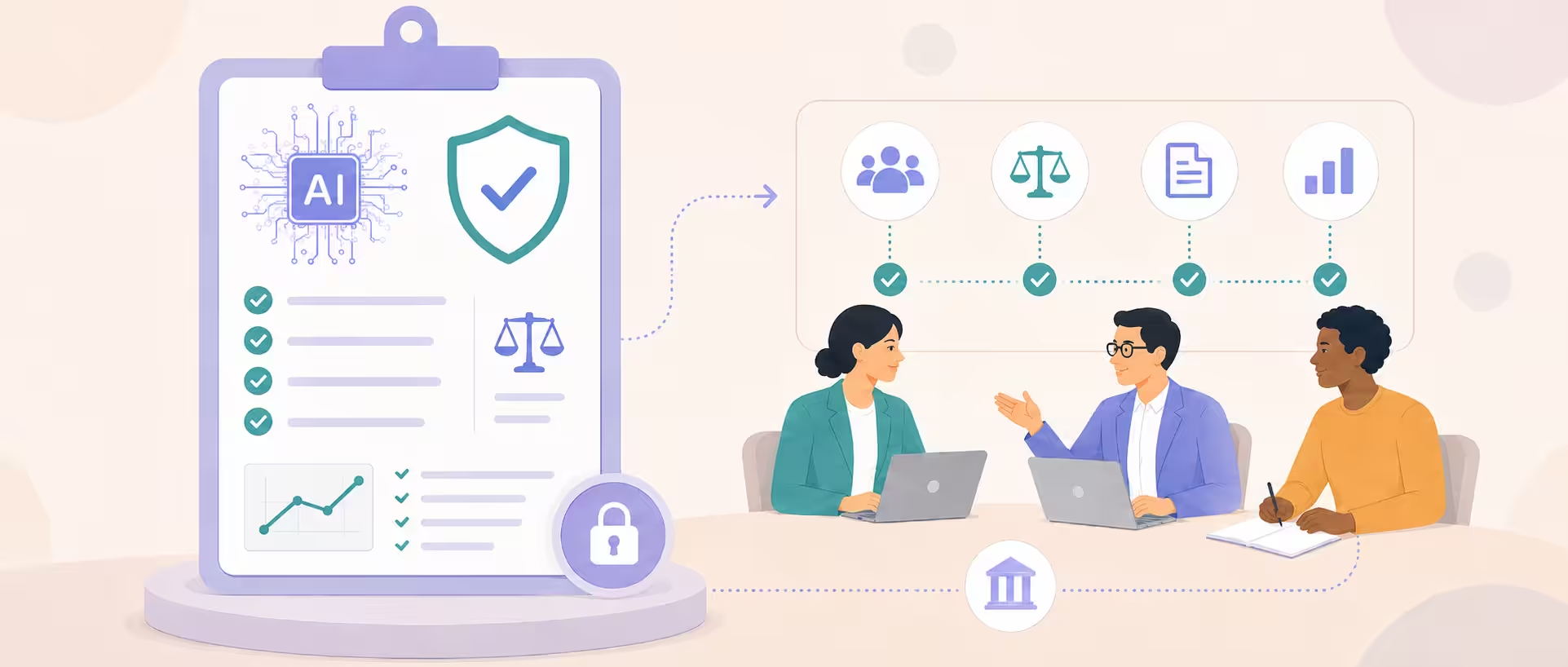
Defensibility should therefore be measured across four dimensions: scientific validity, governance readiness, candidate fairness, and post-hire outcomes. A hiring process that performs across all four is more likely to withstand scrutiny because it is designed around evidence, not assumption.
6. The executive test for defensible hiring
The executive test is simple: could your organization explain and defend the hiring decision if it were questioned?
That question should be asked before a new assessment is deployed, before a screening criterion is scaled, and before a hiring workflow begins influencing candidate movement at volume. The stronger version of the question has several parts.
- Can the organization explain what the assessment measures?
- Can it show why those capabilities matter for the job?
- Can it document how the assessment was validated?
- Can it monitor adverse impact and respond when outcomes require attention?
- Can it show where human judgment enters the decision?
- Can it connect pre-hire signals to post-hire outcomes?
If the answer is unclear, the process is not ready for scrutiny.
Talent acquisition teams will keep looking for ways to move faster, manage volume, and identify people with future-ready capability. Speed will matter. Candidate experience will matter. Cost control will matter. None of those outcomes can compensate for a hiring process that cannot explain itself.
Defensible hiring starts with validated, job-relevant assessment. It keeps human judgment accountable, monitors fairness, and connects hiring signals to business outcomes. That is how hiring leaders protect quality of hire, reduce risk, and build a workforce the business can trust.
Stop treating hiring speed as proof of hiring strength. Start making every signal defendable.
Sources
1 Gartner. “Gartner Says AI Revolution and Cost Pressures Are Two Forces Driving the Top Four Trends for Talent Acquisition in 2026.” 2025.
https://www.gartner.com/en/newsroom/press-releases/2025-10-07-gartner-says-ai-revolution-and-cost-pressures-are-two-forces-driving-the-top-four-trends-for-talent-acquisition-in-2026
2 U.S. Equal Employment Opportunity Commission. “Employment Tests and Selection Procedures.” 2007.
https://www.eeoc.gov/laws/guidance/employment-tests-and-selection-procedures
3 U.S. Equal Employment Opportunity Commission. “Questions and Answers to Clarify and Provide a Common Interpretation of the Uniform Guidelines on Employee Selection Procedures.” 1979.
https://www.eeoc.gov/laws/guidance/questions-and-answers-clarify-and-provide-common-interpretation-uniform-guidelines
4 Harver. “Predictive Assessments Backed by Science.” 2026.
https://harver.com/assessments/
5 Harver. “Skills-Based Hiring.” 2026.
https://harver.com/solutions/use-case/skills-based-hiring/
6 Harver. “How Paramount Advertising increased workforce ethnic diversity by 254% and reduced attrition by 56%.” 2026.
https://harver.com/clients/tech-media-telecommunications/paramount/