TL;DR: AI readiness exposes a measurement gap across the talent lifecycle: organizations are hiring for AI-enabled work while often lacking comparable evidence on whether existing employees can adapt, be developed, or be redeployed as roles change. Resumes, credentials, self-reported tool experience, training completion, and unstructured interviews provide limited decision quality because they do not reliably show applied judgment, adaptability, learning agility, or role-relevant performance potential. A defensible AI workforce strategy requires consistent, validated signals across candidates and employees so leaders can determine where to hire, where to develop, where to redeploy, and where work itself must be redesigned. Without that evidence base, AI talent decisions risk increasing external hiring costs, weakening internal mobility, misallocating training investment, and reducing confidence in workforce-related ROI.
*****
That is not a criticism. It is a structural problem. The tools organizations use to evaluate candidates including assessments, structured interviews, skills criteria, rarely get applied to the people already in the building. So leaders end up with two talent populations measured by completely different standards, and no reliable way to make decisions across both. AI has moved faster than most organizations’ ability to measure the talent implications behind it. McKinsey’s 2025 global AI survey found that 88% of organizations now report regular AI use in at least one business function, while only about one-third have begun scaling AI across the enterprise and 39% report enterprise-level EBIT impact from AI.1 That gap should concern every CEO, CFO, CHRO, COO, and Head of Talent Acquisition trying to connect AI investment to productivity, cost control, and workforce performance.
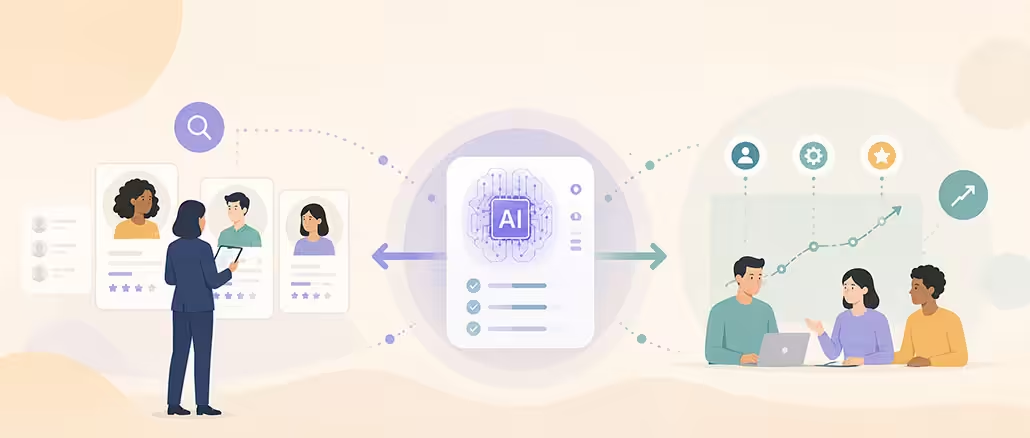
The pressure is arriving from two directions at once. Organizations need to hire people who can work effectively with AI, and they need to understand whether their existing employees can adapt as roles, workflows, and expectations change. Treating those as separate talent questions creates risk. Hiring AI-ready candidates without measuring internal readiness can lead to unnecessary external spend, weaker redeployment decisions, and avoidable knowledge loss. Assessing existing employees without changing hiring signals can leave the organization replenishing the workforce with people who are unprepared for the work ahead.
The AI talent question has two sides: who should we bring in, and who can we develop, redeploy, or advance from within? Leadership teams that answer only one side will make incomplete decisions.
1. AI Readiness Is Now a Business Performance Requirement, Not an HR Metric
The World Economic Forum’s Future of Jobs Report 2025 found that employers expect 39% of workers’ core skills to change by 2030, with AI and big data, technological literacy, analytical thinking, resilience, flexibility, agility, curiosity, and lifelong learning among the skills gaining importance.2 That kind of shift requires a more precise view of capability than resumes, job titles, tenure, or training completion can provide.
AI readiness is also becoming a business performance issue because AI value depends heavily on how people adapt to new workflows. BCG’s 2026 analysis states that, in its 10-20-70 breakdown of AI value, approximately 10% comes from algorithms, 20% from technology, and 70% from rethinking the people component3 Bain similarly argues that workflow modernization and workforce modernization must move together, because workforce change that trails workflow redesign can lead to lower adoption, weaker scaling, disappointing return on investment, workforce disengagement, and technology skepticism.4
For senior leaders, the implication is direct. AI readiness cannot sit only inside learning and development, recruiting, or workforce planning. It belongs in the operating model. If AI changes how work gets done, leaders need reliable signals about who can use AI with judgment, who can adapt quickly, who needs development, and which roles require external hiring.
2. Why Traditional Hiring Signals Fail to Identify AI-Ready Candidates
Talent acquisition teams are already under pressure to move faster, reduce cost, manage application volume, and support business functions that are redefining roles around AI. Gartner identified the AI revolution and cost pressure as two forces driving talent acquisition trends for 2026, including AI-first high-volume recruiting, shifting recruiter skills, redesigned early-career programs, and changes in how organizations assess talent.5
That pressure creates a dangerous shortcut: screening for AI readiness through weak proxies. A candidate’s resume may show exposure to AI tools, but it does not prove judgment. A credential may suggest training, but it does not prove adaptability in a real workflow. A polished interview answer may reflect confidence, preparation, or AI-assisted scripting rather than job-relevant capability. A self-reported proficiency rating may show interest, but it does not create a defensible hiring signal.
The cost of weak screening signals rises when roles are changing quickly. Hiring someone who can describe AI is different from hiring someone who can apply it responsibly, adapt when the tool changes, evaluate output quality, and make sound decisions in the flow of work. That distinction matters for quality of hire, time-to-capacity, early attrition, and Return on Talent Investment, or ROTI.
Skills-based hiring gives talent acquisition leaders a stronger foundation because it starts with the work. Harver’s skills-based hiring approach includes job analysis, predictive assessments, evidence-based validation, AI with human oversight, and the ability to connect pre-hire skills data to post-hire outcomes such as retention and promotability.6 In an AI-shaped labor market, that discipline becomes more important because the surface signals of AI-ready candidates present are becoming less reliable.
3. How to Assess AI Readiness in Your Existing Workforce — Not Just New Hires
Many organizations are looking outward for AI-ready talent while under-measuring the capability already inside the business. That creates cost and risk. External hiring may be necessary in specific areas, but leaders need to know when the internal workforce can be developed, redeployed, or advanced into AI-augmented roles faster than the organization can hire externally. Leaders need to know the current state of their employee AI readiness.
Bain’s 2026 workforce modernization analysis emphasizes dynamic reskilling and redeployment as part of the link between workflow modernization and workforce modernization.4 BCG’s 2026 analysis also found that future-built companies plan to upskill more than 50% of employees on AI, compared with 20% for laggards, and are four times more likely to have structured AI-learning programs and protected learning time.3
The executive issue is not training volume. It is whether the organization can see which employees are ready to apply AI in role-relevant ways. Training participation does not prove readiness. Completion data does not show whether someone can evaluate output, manage risk, adapt to workflow changes, or make sound decisions with AI in context. Leaders need a measurable view of aptitude, practical judgment, learning agility, and adaptability.
This is where the candidate and employee sides of the AI talent question come together. Harver AI PREVAIL is designed to measure AI skills, aptitude, and adaptability across hiring and the existing workforce, with an emphasis on the ability to understand, adapt to, and work effectively with AI in real work contexts.7 That matters because the same organization may need to screen external candidates, evaluate internal mobility potential, identify development needs, and make workforce planning decisions from a consistent measurement foundation.
The point is not to turn assessment into a replacement for leadership judgment. The point is to give leadership judgment better evidence.
4. The AI Workforce framework: hire, develop, redeploy, or redesign
Once leaders have a reliable view of AI readiness, the workforce conversation becomes more practical. The organization can move away from generic statements about AI skills and toward AI talent strategy decisions that affect productivity, capacity, and cost.
A useful executive framework starts with four decisions.
Hire – Develop – Redeploy – Redesign.
Hire: Which roles require AI-ready talent that the organization cannot develop fast enough internally? This is where talent acquisition needs validated screening signals, job-relevant criteria, and a clear definition of what AI readiness means for the role.
Develop: Which employees show the aptitude and learning agility to become more effective in AI-augmented workflows with targeted support? This is where training investment can become more precise, because the organization is matching development to measured readiness rather than broad assumptions.
Redeploy: Which employees could move into adjacent roles where their institutional knowledge and AI readiness create stronger business value? This is where internal mobility becomes a performance lever rather than a retention slogan.
Redesign: Which roles or workflows need to change because AI has altered the task mix, decision points, or collaboration model? This is where job analysis becomes essential, because leaders need to understand how the work itself is changing before deciding what talent the business needs.
This framework gives CHROs and talent leaders stronger language for CEO and CFO conversations. The discussion becomes less about hiring volume, training participation, or automation targets, and more about workforce capability, time-to-capacity, redeployment potential, attrition risk, and ROTI.
5. The Real Problem in AI Hiring: Signal Quality, Not Hiring Speed
The pain inside talent acquisition is not only workload. It is signal quality. Recruiting teams are being asked to move faster in a labor market where roles are changing, candidate materials are easier to optimize, and business leaders want more confidence that new hires can perform in AI-shaped work.
Gartner’s 2026 talent acquisition outlook notes that AI is changing nearly every aspect of how business is done and that talent acquisition leaders must address how AI reshapes assessment.5 McKinsey’s 2025 AI survey also found that high performers are more likely to redesign workflows and define when model outputs require human validation.1 The same logic applies to hiring. The more AI changes work, the more carefully organizations need to define what they are measuring and where human judgment belongs.
Recruiters do not need more noise. They need stronger evidence. Hiring managers do not need longer interview loops. They need clearer signals before the final decision. Candidates do not need more opaque screening. They need a fair opportunity to demonstrate what they can actually do.
A valid signal should be job-relevant, consistent, explainable, and connected to outcomes. It should reduce reliance on credentials that may not predict performance in AI-augmented roles. It should help the organization identify people with demonstrated capability, not only people with the most polished presentation of experience.
The value of stronger talent signals is already visible in organizations that have moved away from reactive hiring. Paramount Advertising used Harver to support a more standardized, data-driven entry-level sales hiring process. The company reported a 254% increase in ethnic diversity, a 56% reduction in attrition, a 12% increase in employee performance, and a 30% reduction in recruiting time.8 The AI readiness context is different, but the decision principle carries over: when leaders define the capabilities that matter and measure them consistently, talent decisions become more predictive, fairer, and easier to improve.
That is the reason AI hiring needs assessment discipline. Speed without validity creates risk. Automation without measurement creates false confidence. Human judgment without structured evidence creates inconsistency. The strongest talent systems combine science-based measurement with accountable human decision-making.
6. Building an AI Readiness Assessment Strategy Across the Full Talent Lifecycle
The organizations that build advantage from AI will not only buy tools, redesign workflows, or hire people with AI keywords on their resumes. They will understand which capabilities predict performance in AI-augmented work, which employees can adapt, which candidates bring real readiness, and where the organization should hire, develop, redeploy, or redesign.
That requires one measurement philosophy across the talent lifecycle. Candidates and employees should not be evaluated through disconnected assumptions. If AI readiness matters to performance, it should be defined, measured, and governed with the same discipline leaders expect from any other business-critical capability.
The two sides of the AI talent question are now inseparable. Talent acquisition needs valid signals to identify AI-ready candidates. Workforce leaders need valid signals to understand the readiness of existing employees. CEOs and CFOs need confidence that workforce decisions are improving performance rather than adding hidden cost.
AI will keep changing the work. The leadership task is to stop guessing which people can change with it.
Sources
- McKinsey & Company. “The State of AI: Global Survey 2025.” 2025. https://www.mckinsey.com/capabilities/quantumblack/our-insights/the-state-of-ai
- World Economic Forum. “The Future of Jobs Report 2025.” 2025. https://www.weforum.org/publications/the-future-of-jobs-report-2025/
- Boston Consulting Group. “AI Transformation Is a Workforce Transformation.” 2026. https://www.bcg.com/publications/2026/ai-transformation-is-a-workforce-transformation
- Bain & Company. “Want More Out of Your AI Investments? Think People First.” 2026. https://www.bain.com/insights/want-more-out-of-your-ai-investments-think-people-first/
- Gartner. “Gartner Says AI Revolution and Cost Pressures Are Two Forces Driving the Top Four Trends for Talent Acquisition in 2026.” 2025. https://www.gartner.com/en/newsroom/press-releases/2025-10-07-gartner-says-ai-revolution-and-cost-pressures-are-two-forces-driving-the-top-four-trends-for-talent-acquisition-in-2026
- Harver. “Skills-Based Hiring.” 2026. https://harver.com/solutions/use-case/skills-based-hiring/
- Harver. “AI PREVAIL Demo.” 2026. https://harver.com/ai-prevail-demo/
- Harver. “How Paramount Advertising increased workforce ethnic diversity by 254% and reduced attrition by 56%.” 2026. https://harver.com/clients/tech-media-telecommunications/paramount/